
Maintenance management
What is a CMMS? Definition, functions, and how to implement one in a plant
Nearly every plant keeps maintenance records. The trouble is that those records rarely help anyone make a decision. A CMMS exists to close that gap: it turns the daily work of technicians into an asset history that can be traced, measured, and learned from.

Key takeaways
- A CMMS (Computerized Maintenance Management System) is an information system that records all maintenance work and ties each job to the asset it was performed on.
- It has six core functions: the asset register, work orders, scheduled maintenance, spare parts, checksheets, and performance reporting.
- The value of a CMMS is set not by its features but by recording discipline. Metrics such as MTBF and MTTR are only as accurate as the data that goes in.
- Successful implementations usually start in one area with critical assets, not across the entire plant at once.
What a CMMS is
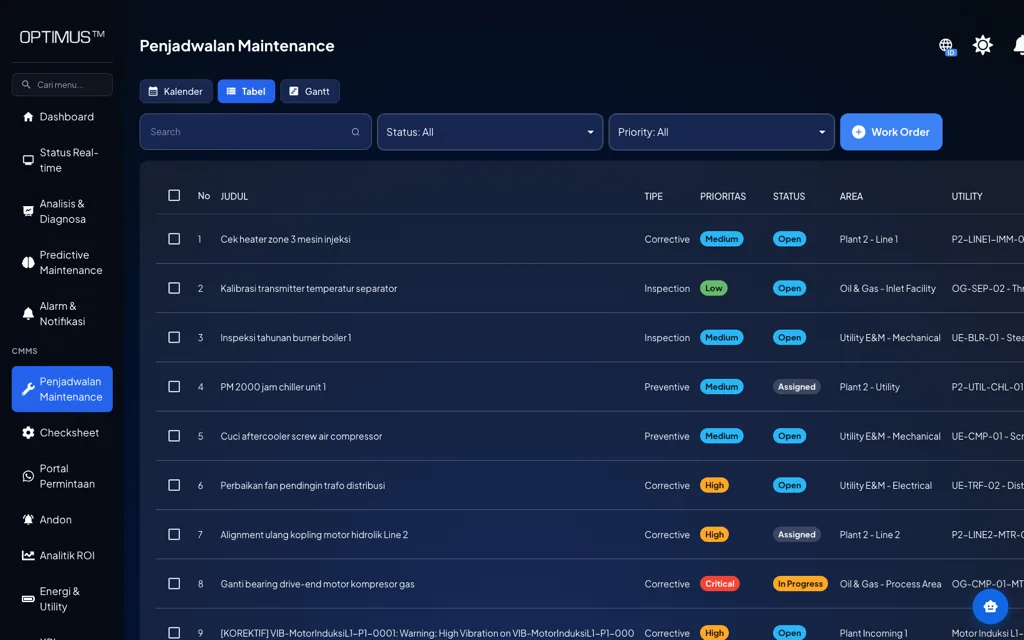
CMMS stands for Computerized Maintenance Management System. Put simply, a CMMS is software that helps a maintenance team plan work, carry it out, and store the results in a single, structured database.
To understand what a CMMS manages, it helps to go back to the definition of maintenance itself. The European standard EN 13306 defines maintenance as the combination of all technical, administrative, and managerial actions during the life cycle of an item, intended to retain it in, or restore it to, a state in which it can perform the required function[1]. The definition matters because it makes clear that maintenance is not only about wrenches and grease. There is an administrative and managerial side that carries just as much weight, and that is the side where a CMMS does its work.
The central idea of a CMMS is simple: every job is tied to a specific asset. When a technician replaces a bearing on pump P-101, the record does not end up as a line in the workshop logbook. It becomes part of the history of pump P-101, complete with the date, cause, duration, and spare parts used. Over months, that history becomes material for analysis: which assets fail most often, how long repairs take on average, and whether the preventive maintenance schedule is actually being followed.
Why maintenance records so often fall short
Consider a fairly common scenario. At 2 a.m., the cooling pump on line two stops. The night-shift technician fixes it, production resumes, and a short report goes out to the WhatsApp group. Three months later the same pump stops again with the same symptoms. The technician on duty this time is someone else, with no idea the problem has happened before.
Situations like this do not come from negligence. They come from the way information is stored. Knowledge about the machines is scattered across the heads of senior technicians, paper checksheets piling up in a cabinet, and chat messages buried under other conversations. As a result, the plant loses three things at once: a history that can be traced, patterns that can be analyzed, and a measure of whether maintenance is getting better or worse.
Where a CMMS fits in maintenance strategy
The literature generally distinguishes several approaches to maintenance. Corrective maintenance is performed after a failure has occurred. Preventive maintenance is performed at fixed intervals of time or usage, for example every 2,000 operating hours. Condition-based maintenance is performed when monitoring shows that condition is deteriorating, following the framework set out in ISO 17359[7]. Predictive maintenance uses trends in condition data to estimate when action will be needed.
The more fundamental question is which approach suits which asset. That question is answered by the Reliability-Centered Maintenance (RCM) framework, popularized by Moubray[2] and rooted in the study by Nowlan and Heap for the aviation industry[3]. One of the most influential findings of that study was that most components do not show a clear wear-out pattern as they age.
A · Bathtub curve · 4%
B · Wear-out at end of life · 2%
C · Gradually increasing · 5%
D · Low, then constant · 7%
E · Random, constant · 14%
F · High early, then constant · 68%
In the Nowlan and Heap data, only about 11 percent of components (patterns A, B, and C) showed a clear relationship between age and failure[3]. The rest failed at random or were most vulnerable early in their service life. The practical implication: replacing components purely by the calendar does not always lower the risk of failure, and for pattern F it can even raise it, because every replacement brings back the vulnerable early period.
This is where a CMMS becomes a foundation rather than just an administrative aid. To know the failure pattern of an asset, you need a well-kept failure history: when failures occurred, what caused them, and what was replaced. Without that data, the choice of maintenance strategy rests on habit or on the manufacturer's general recommendations.
Core functions of a CMMS
CMMS products differ in scope and interface, but their core functions are fairly consistent. The six functions below are a useful reference when evaluating a system.
1. Asset register and hierarchy
The asset register is a list of all the equipment being maintained, organized as a hierarchy: plant, area, line, machine, and down to component. ISO 14224 provides an example taxonomy that is widely used as a reference for building this hierarchy and for grouping reliability data consistently[4]. A good register also records the criticality of each asset, because not every machine deserves the same level of attention.
2. Work order management
The work order is the unit of work in a CMMS. Every work order follows a clearly defined life cycle, so its status can be tracked by anyone with a stake in it, from the technician to the plant manager.
- 01Request
- 02Approval
- 03Planning
- 04Scheduling
- 05Execution
- 06Closeout
- 07Analysis
The stage most often neglected is closeout. A work order closed without recording the cause of failure, the duration, and the spare parts used will still show as complete on screen, but it contributes nothing to the analysis that follows.
3. Scheduled preventive maintenance
A CMMS generates preventive work orders automatically from defined triggers: a calendar interval (every month, for instance), usage (operating hours or cycle counts), or condition (a vibration reading crossing a threshold, for example). The schedule no longer depends on someone's memory, and missed jobs become visible right away.
4. Spare parts and inventory
When spare parts consumption is recorded against work orders, the plant can see which components are replaced most often and on which assets. That information supports more sensible minimum stock levels than simply repeating last year's purchasing habits.
5. Checksheets and inspections
Digital checksheets replace paper forms. Inspection results are stored in a uniform format and can be searched, and any abnormal finding can be turned straight into a corrective work order.
6. Reporting and performance metrics
This last function is the main reason most organizations adopt a CMMS in the first place: the ability to measure. The next section covers the metrics in most common use.
Maintenance performance metrics you can measure
The Society for Maintenance & Reliability Professionals (SMRP) publishes a set of maintenance and reliability metric definitions that is widely used as a reference in industry[5]. Wireman also discusses in detail how such metrics are structured in tiers, from the corporate level down to the execution level[6]. Some of the most basic metrics are summarized below.
Mean Time Between Failures (MTBF)
MTBF = total operating time ÷ number of failures
The higher the MTBF, the less often the asset fails.
Mean Time To Repair (MTTR)
MTTR = total repair time ÷ number of repairs
The lower the MTTR, the faster the asset returns to service after a failure.
Inherent availability
Aᵢ = MTBF ÷ (MTBF + MTTR)
The proportion of time the asset is ready to operate, counting only corrective repair time.
| Metric | How it is calculated | What it shows |
|---|---|---|
| MTBF | Operating time ÷ number of failures | Asset reliability |
| MTTR | Repair time ÷ number of repairs | Speed of recovery |
| PM compliance | PMs completed on time ÷ PMs scheduled | Discipline in following the schedule |
| Planned work percentage | Planned labor hours ÷ total labor hours | How reactive the team is |
| Backlog | Pending labor hours ÷ weekly labor hour capacity | Workload that is piling up |
Detailed definitions and boundaries for each metric follow SMRP Best Practices [5].
Keep in mind that a metric is only as accurate as the data behind it. If technicians close work orders without recording when the machine stopped and when it started running again, the resulting MTTR means nothing. For that reason, CMMS forms should require the data the metrics actually need, and nothing more.
CMMS, EAM, and ERP: what is the difference?
The term CMMS is often confused with EAM (Enterprise Asset Management) and with the maintenance module of an ERP system. The three overlap, but their emphasis differs. EAM generally covers the entire asset life cycle, from acquisition to disposal, in line with the asset management principles of ISO 55000[8]. A CMMS focuses on executing and measuring day-to-day maintenance work.
| Aspect | CMMS | EAM | ERP maintenance module |
|---|---|---|---|
| Primary focus | Day-to-day maintenance execution | The full asset life cycle | Integration with finance and procurement |
| Primary users | Technicians, planners, supervisors | Asset management, finance, maintenance | Finance, procurement, maintenance |
| Depth of maintenance features | High | High | Varies |
| Implementation time | Relatively short | Longer | Tied to the ERP project |
In practice, many plants run a CMMS for field work and connect it to the ERP for purchasing and cost. This is often more realistic than forcing technicians to work directly in an ERP interface that was never designed for them.

Steps to implement a CMMS in a plant
CMMS implementations rarely fail because of the software. More often, the cause is messy starting data and work habits that never changed. The sequence below is designed to reduce both risks.
- Set goals and metrics first. For example: raise PM compliance in the utilities area, or cut MTTR on a particular line. Clear goals determine what data must be recorded.
- Build the asset register and assign criticality. Start with the assets whose downtime has the greatest impact on production, safety, or quality.
- Standardize failure codes. A simple list of failure modes, causes, and actions makes the data analyzable. Without one, every technician describes the same problem in different words.
- Start with a pilot area. One area with critical assets is enough to test the workflow, the forms, and the team's habits before expanding.
- Make input easy in the field. Technicians will record work if it is quick, for example on a phone next to the machine, and will put it off if they have to walk back to a computer in the office.
- Keep work order closeout disciplined. Decide who verifies closeout and what minimum data must be complete.
- Review regularly. Look at the metrics every month or quarter, then adjust the preventive schedule based on actual failure history.
Common mistakes to avoid
- Migrating all legacy data at once. Inconsistent historical data pollutes the analysis. It is better to start clean and build up the history gradually.
- Forms that are too long. Every extra field lowers the chance that the form gets filled in correctly.
- A CMMS used only by management. If technicians see no benefit, such as finding a machine's history more easily, recording will slowly decline.
- Metrics without follow-up. Reports that are never discussed in a meeting will not change anything on the shop floor.
How a CMMS relates to condition monitoring
A CMMS records what people do. Condition monitoring records what the machine experiences, such as vibration, temperature, and electrical current. The two complement each other. ISO 17359 describes a condition monitoring process that ends in a decision on maintenance action[7], and that decision is most effective when it becomes a work order in the CMMS directly.
Integrating the two also closes a loop that is often missed: post-repair verification. Once a work order is closed, condition data should show whether the repair actually returned the machine to normal. Without this check, a work order can be marked complete while the root cause has not been touched.
Conclusion
At its core, a CMMS is a disciplined way of remembering. It stores every maintenance job against the asset concerned, so the plant can learn from its own history: which assets are troublesome, which strategies work, and whether the team's performance is improving. The software matters, but what decides the outcome is data quality, simple workflows in the field, and the habit of reviewing metrics on a regular basis.
For a plant just getting started, the most sensible step is to pick one area with critical assets, settle on two or three metrics, and keep up recording discipline for a few months. The results from that pilot area are the strongest basis for a wider rollout.
Frequently asked questions
What does CMMS stand for?
CMMS stands for Computerized Maintenance Management System, a computer-based system for planning, recording, and measuring maintenance work.
What is the difference between a CMMS and an EAM system?
A CMMS focuses on executing and measuring day-to-day maintenance work, while EAM covers the entire asset life cycle, including acquisition, finance, and asset disposal.
Is a CMMS only suitable for large plants?
No. Small and mid-sized plants often see the benefits sooner, because their maintenance history usually depends on a handful of people. Implementation can start in one area with critical assets.
Which metrics should be measured first?
In the early stages, preventive maintenance compliance and MTTR are usually the easiest to measure correctly. MTBF becomes meaningful once several months of failure history have been collected.
Can a CMMS connect to machine sensors?
Yes. Condition monitoring data, such as vibration or temperature crossing a threshold, can trigger work orders automatically and can be used to verify the results of a repair.
References
- [1]European Committee for Standardization. (2017). EN 13306:2017, Maintenance: Maintenance terminology. CEN.
- [2]Moubray, J. (1997). Reliability-centred maintenance (2nd ed.). Butterworth-Heinemann.
- [3]Nowlan, F. S., & Heap, H. F. (1978). Reliability-centered maintenance (Report No. AD-A066579). United States Department of Defense.
- [4]International Organization for Standardization. (2016). ISO 14224:2016, Petroleum, petrochemical and natural gas industries: Collection and exchange of reliability and maintenance data for equipment. ISO.
- [5]Society for Maintenance & Reliability Professionals. SMRP Best Practices: Maintenance & reliability metrics. SMRP.
- [6]Wireman, T. (2005). Developing performance indicators for managing maintenance (2nd ed.). Industrial Press.
- [7]International Organization for Standardization. (2018). ISO 17359:2018, Condition monitoring and diagnostics of machines: General guidelines. ISO.
- [8]International Organization for Standardization. (2024). ISO 55000:2024, Asset management: Vocabulary, overview and principles. ISO.