
Operations & visualization
What is an andon system? Origins, how it works, and its digital form
Every production line has small problems: a part that does not fit, a tool that misbehaves, material that arrives late. The question is whether the problem is dealt with where it appears, or quietly passed on to the next station. The andon system is Toyota's answer to that question.
Key takeaways
- Andon is a signal operators use to call for help when a problem occurs, so that the problem is dealt with where it starts and is not passed on to the next process.
- Andon comes from the Toyota Production System and the principle of jidoka: stop to fix a problem instead of passing it on.
- Digital andon routes each call to the right team by category, escalates on timers, and records response time and resolution time.
- Andon only works when every call gets a response and the operator who calls is welcomed, not blamed.
What an andon system is
Andon is a Japanese word that literally means a paper lantern, the traditional lamp made of a wooden frame covered in paper. On the production floor, the term is used for something far more practical: a signal that operators use to call for help when a problem occurs, whether a jammed machine, the wrong material, a doubt about quality, or a task that cannot be finished within its cycle time.
An andon system is the whole mechanism around that signal: a device to trigger the call (a cord, a button, or a screen), a display that tells everyone where the problem is, a person who is obliged to respond, and rules about what happens when no response comes. In the Toyota Production System, the andon board is a tool of visual control: the state of the line is made visible, so anyone can see where work has stopped without having to ask[1].
What sets andon apart from an ordinary alarm is the direction of flow. An alarm is usually triggered by a machine when a value crosses a limit. Andon is triggered by the person closest to the problem, and its purpose is to bring help before the problem is passed on to the next station. In modern practice the two are often combined, but the basic idea stays the same: a problem is reported where and when it happens.
Origins: the Toyota Production System and jidoka
Andon grew out of the Toyota Production System (TPS), which Taiichi Ohno described as resting on two pillars: just-in-time and jidoka[1]. Just-in-time ensures that only what is needed is made, when it is needed, in the amount needed. Jidoka, which Ohno also called autonomation or automation with a human touch, governs what happens when a process runs abnormally.
The roots of jidoka lie in the automatic loom designed by Sakichi Toyoda, which stopped by itself when a thread broke[1]. A machine that knows when to stop no longer needs one person watching it constantly, and defective cloth is not produced on and on without anyone noticing. On an assembly line run by people, that "stop by itself" role passes to the operator: everyone on the line is given the right, and the duty, to stop work as soon as they see something abnormal.
Womack, Jones, and Roos drew this contrast sharply in their study of the automotive industry. In mass-production plants, stopping the line was treated as a major decision that only senior managers could take, so defects were passed along and fixed in rework areas at the end of the line. At Toyota, Ohno placed a cord above every workstation and asked workers to stop the line if they found a problem they could not fix themselves. At first the line stopped often, but as root causes were solved one by one, the stops became less frequent[2].
Liker framed this idea as one of the principles of the Toyota Way: build a culture of stopping to fix problems, to get quality right the first time[3]. The reason is practical. A defect found at the station where it happened still carries clues about its cause: the tool in use, the material just opened, the operator who can be asked. A defect found at the end of the line, or by the customer, has lost most of those clues.
How a classic andon works
The details of an andon system differ from plant to plant, but a classic andon on an assembly line generally has four elements that work in sequence.
- Trigger. A cord running along the line or a button at each station. The operator pulls it as soon as something is abnormal: a part that does not fit, a tool problem, or work falling behind the cycle time.
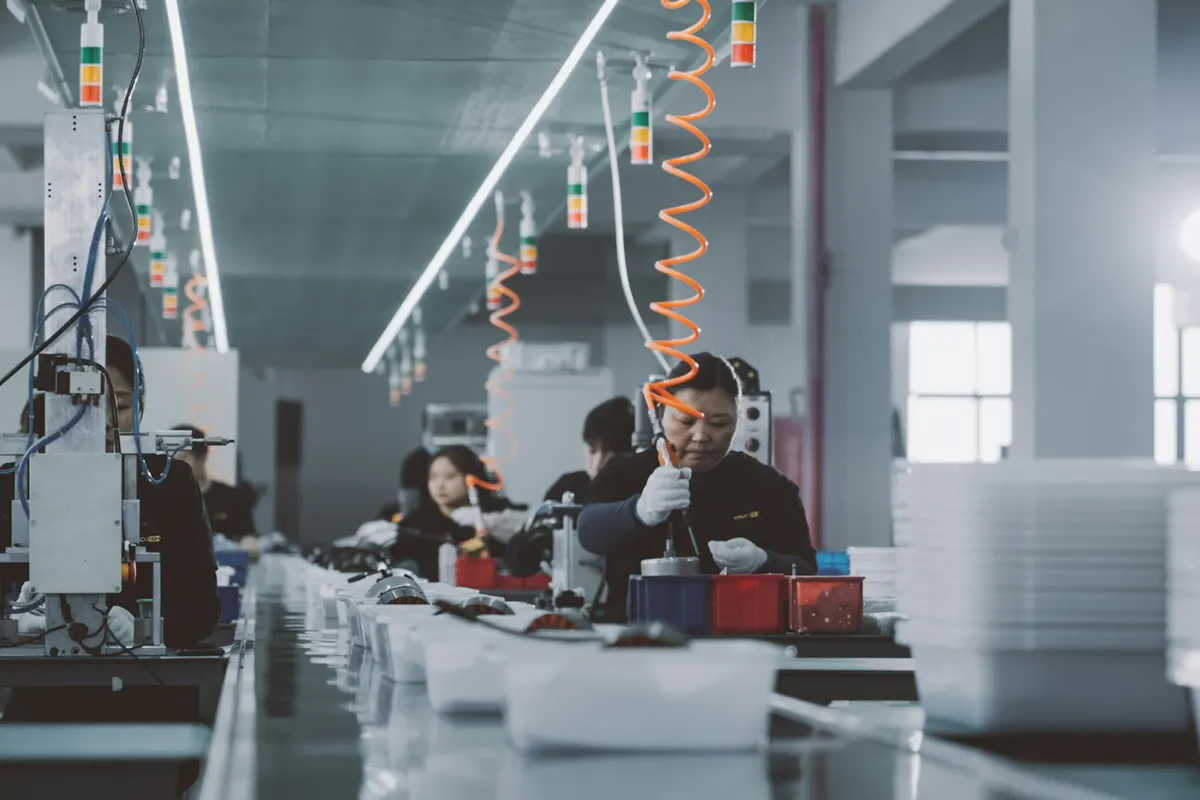
- Andon board. A board of lights hung high so it can be seen from many angles, showing which station is calling and where the line has stopped[4]. The board is usually paired with a sound, so the call is heard as well as seen.
- Team leader response. A designated person, usually the team or group leader, goes to the station, sees the problem first-hand, and helps solve it. If the problem is resolved, the call is switched off and work continues.
- Escalation. If the problem is not resolved within the set limit, the decision moves up a level: the line is stopped, or a supervisor and support functions such as maintenance and quality are called in.
Liker describes the variant used on Toyota assembly lines as a fixed-position stop. Pulling the cord calls the team leader, but the line does not stop at once. The line stops only if the problem is still unresolved when the unit reaches the end of that station's work zone[3]. This way, a small problem that is solved in a few seconds does not stop the whole line, while a bigger problem cannot be passed on silently.
It is worth noting that andon calls are not only about machine breakdowns. On an assembly line, most calls are in fact about small things: a missing part, a bolt that will not go in, a misprinted label, or a new operator unsure of the work sequence. On process lines such as injection molding or packaging, calls are more often machine-related: a sticking mold, a clogged sensor, or an unstable temperature. The call categories therefore need to reflect what actually happens on each line.
Color conventions differ between plants
Many andon boards use color to distinguish conditions, for example one color for a call for help and another for a stopped line. There is, however, no single color standard that applies everywhere. Some plants use yellow for a call and red for a stop, others use color to separate problem types such as machine, material, or quality, and stack lights on machines often carry their own conventions from the manufacturer.
The life cycle of an andon call
Seen in terms of time, every andon call passes through the same five stages, whether the system is classic or digital.
- 01Signal
- 02Notify
- 03Respond
- 04Resolve
- 05Record
The signal happens when the operator pulls the cord or presses the button. Notify is the moment the call reaches the person who must respond, through a light, a sound, or a message. Respond begins when that person arrives at the station and starts dealing with the problem. Resolve is the moment the problem is fixed and work returns to normal. Record keeps what happened: where, when, what kind of problem, and how long each stage took.
With a classic andon, the last stage is often lost. The light goes out, the line runs again, and all that remains is the team leader's memory or a handwritten note at the end of the shift. Yet the time between signal and response, and between response and resolution, are the two most useful pieces of information for improvement. This is where the digital version makes its biggest difference.
Digital andon: a signal that reaches the right person
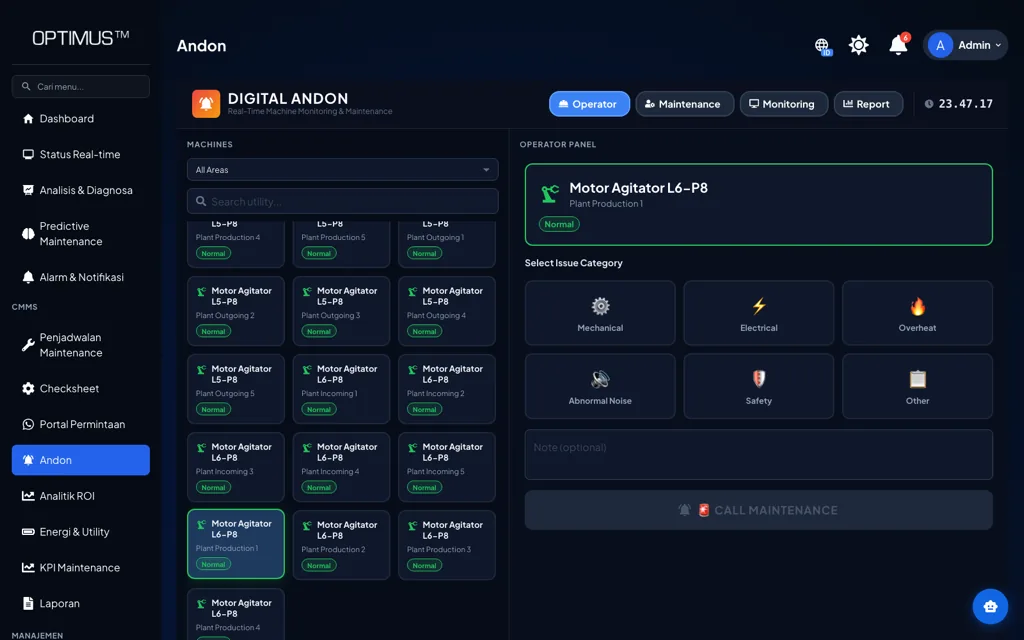
Digital andon moves the trigger and the board onto electronic devices: networked buttons, touch panels at the station, or an app on a tablet. Lights and sounds are still useful on the production floor, but every call now also becomes a data record with a time, a location, and a category. Three capabilities set it apart from an ordinary light board.
Calls are routed by category
With a classic andon, every call lights the same lamp, and the team leader who arrives has to judge who is needed. With a digital andon, the operator picks a category when calling, for example mechanical, electrical, material, or quality, and the system routes the call straight to the team that handles that category. A leaking hydraulic pump on an injection molding machine during the night shift goes directly to the mechanical technician on duty, without passing through three people first.
Escalation on timers
Escalation rules that, with a classic andon, depend on people's memory and alertness can be written as system rules. If a call has no response within the first limit, the notification goes up to the supervisor; if it is still unresolved at the next limit, it goes up again to the department head. The time limits are set by the plant itself, according to the impact of the problem and the number of people available on each shift. A fully stopped line reasonably gets a shorter limit than a call about a misprinted label.
Response and resolution times are recorded
Because every stage carries a timestamp, the system records how long a call waited for a response and how long the problem took to resolve. This data changes the conversation in production meetings. Instead of an impression that "the technicians are often slow to reach line 3", the team can see at what hours, for which categories, and on which shifts calls wait longest. Calls that need deeper repair can also be turned into a work order in the CMMS, so the history of the problem and its repair stays connected.
| Aspect | Classic andon | Digital andon |
|---|---|---|
| Trigger | Cord or button at the station | Networked button, touch panel, or app |
| What a call carries | Station location | Location, machine, problem category, and time |
| Recipient | Team leader who sees the board | Team matching the category, via screens and messages |
| Escalation | Depends on people's alertness | Time-limit rules written into the system |
| Record | Memory or handwritten notes | A timestamp for every stage, ready to analyze |
Useful andon metrics
Andon data only becomes useful when it is turned into a few metrics that are reviewed regularly. Two time metrics form the basis.
Response time
Response time = time response starts − time signal is raised
Measures how long the operator waits for help. Reflects the number of people available and how clear the notification path is.
Resolution time
Resolution time = time problem is resolved − time response starts
Measures how long the problem takes to fix once help arrives. Reflects how hard the problem is, spare parts readiness, and skills.
Some plants measure resolution time from the moment the signal is raised rather than from the start of the response. Both are valid as long as the definition is written down and does not change; the mistake is mixing the two in one report.
| Metric | What it measures | How to use it |
|---|---|---|
| Response time | Time from signal until help arrives | Compare by shift and by category to see where the notification path or staffing falls short. |
| Resolution time | Time from response until the problem is resolved | Look for categories with long resolution times; they often point to missing spare parts, procedures, or skills. |
| Calls by category | Number of calls for each problem type | Identify the problem types that take up the most time and are worth an improvement project. |
| Calls by station | Number of calls from each station or machine | Find stations that call repeatedly for the same problem as candidates for root cause analysis. |
| Escalated calls | Share of calls that move up to the next level | Judge whether escalation limits are realistic and whether the first level has enough authority. |
A note on how to summarize response time. The following numbers are illustrative: five calls in one shift get a response in 2, 3, 4, 6, and 10 minutes. The mean is (2 + 3 + 4 + 6 + 10) ÷ 5 = 5.0 minutes, while the median is 4 minutes. The one call that waited 10 minutes pulls the mean up, yet the mean also hides that call itself. So besides the mean, look at the median and a list of the longest waits. An operator who waited a long time on the night shift is a problem that must not disappear into a daily figure.
Culture: andon only works when problems are welcomed
Andon hardware can be bought and installed within weeks. The far harder part is getting operators to use it. An operator who has been scolded for pulling the cord, or who has watched a call go unanswered, quickly learns that it is safer to stay quiet and pass the problem on to the next station.
Liker stresses that at Toyota, stopping work to deal with a problem is seen as the right thing to do, not as an operator failure, and that the system is supported by team leaders ready to respond to every call[3]. One consequence is often missed: a line that almost never calls andon is not necessarily a healthy line. The problems may still be there, just unreported.
In practice, this attitude shows in small things. The first person to arrive asks what the problem is, not whose fault it is. The operator who called is thanked, not asked why the line stopped. And andon data is discussed to find recurring causes, not to rank the stations that are "most troublesome".
Steps to implement an andon system
The sequence below puts response rules before hardware, because andon fails more often from unanswered calls than from its technology.
- Start with one line or area. Choose an area with frequent problems and a supportive leader. Lessons from the first area are worth more than a plant-wide launch all at once.
- Decide who responds and how fast. For every category and every shift, it must be clear who the first recipient is, who the backup is, and when a call moves up a level. Without this, even the best hardware only lights a lamp.
- Keep the category list short. Start with a few categories that directly decide who gets called, for example mechanical, electrical, material, and quality. Categories can be split later if the data shows the need.
- Define what each signal means in writing. Colors, sounds, and screen displays are explained near the board and in operator training.
- Train operators and responders together. Simulated calls show everyone what happens after the button is pressed, including how to close a call properly so that resolution time is recorded accurately.
- Review the data regularly and act on it. Discuss response time, resolution time, and the top categories in a daily or weekly meeting, then pick one recurring problem and solve it down to its root cause.
Common mistakes and limits
Most andon systems that fail do not fail because the hardware breaks. They fail because of the habits around them.
- Calls with no response. This is the most damaging mistake. Every ignored call teaches operators that andon is pointless, and lost trust is far harder to rebuild than the hardware is to install.
- Too many categories. A list of twenty categories makes operators hesitate, then pick the first one or "other". The resulting data looks detailed but cannot be trusted.
- Using the data to blame. If calls per station are used to judge operators, the number of calls will fall because problems are hidden, not because they are solved.
- Calls not closed properly. Calls left open after the problem is fixed, or closed in bulk at the end of the shift, make resolution time meaningless.
- Treating andon as an improvement system. Andon speeds up the response to problems that have already happened, but it does not stop them from coming back. Prevention comes from root cause analysis and planned maintenance, which use andon data as one of their inputs.
Conclusion
The andon system starts from a simple idea: the person closest to a problem must be able to call for help right away, and the problem is dealt with where it occurs, not passed on. The idea is rooted in jidoka within the Toyota Production System, and its physical form, the cord, the button, the light board, and the team leader who comes, is only a way of putting it into practice.
Digital andon adds what the light board always lacked: calls that reach the right person, escalation that does not depend on memory, and time records that can be analyzed. Its value, however, still depends on the same things as a classic andon: every call is answered, every operator who calls is welcomed, and the data is used to improve the process, not to find someone to blame.
Frequently asked questions
What does andon mean?
Andon is a Japanese word that literally means a paper lantern. In manufacturing, andon is a signal operators use to call for help when a problem occurs on the production line.
Where does the andon system come from?
From the Toyota Production System, as part of the principle of jidoka: stop work to fix a problem instead of passing it on to the next process.
What do andon light colors mean?
There is no color standard that applies everywhere. Each plant sets its own conventions, so the meaning of every color needs to be written down and taught to all operators.
What is the difference between a classic and a digital andon?
A classic andon turns on lights and sounds on a board. A digital andon also routes the call to the team matching the problem category, escalates on time limits, and records response time and resolution time.
Does pulling the andon always stop the whole line?
Not always. In many setups the call first brings the team leader, and the line stops only if the problem is not resolved within the set time limit or work zone.
References
- [1]Ohno, T. (1988). Toyota production system: Beyond large-scale production. Productivity Press.
- [2]Womack, J. P., Jones, D. T., & Roos, D. (1990). The machine that changed the world. Rawson Associates.
- [3]Liker, J. K. (2004). The Toyota way: 14 management principles from the world's greatest manufacturer. McGraw-Hill.
- [4]Monden, Y. (2012). Toyota production system: An integrated approach to just-in-time (4th ed.). CRC Press.